FRP Scaffolding Saudi Arabia: Selection and Safety
FRP access equipment may suit projects where electrical hazards, corrosive substances, chemical exposure, environmental conditions, or specialised maintenance requirements influence scaffold selection. However, fibre-reinforced polymer construction alone does not establish suitability or safety. Project teams must consider working height, platform space, loading, mobility, base conditions, contamination, equipment condition, and manufacturer limitations. For FRP scaffolding in Saudi Arabia applications, procurement teams should evaluate the complete system against the task and hazard profile, while site teams should follow approved configurations, inspection procedures, electrical controls, and applicable project requirements.
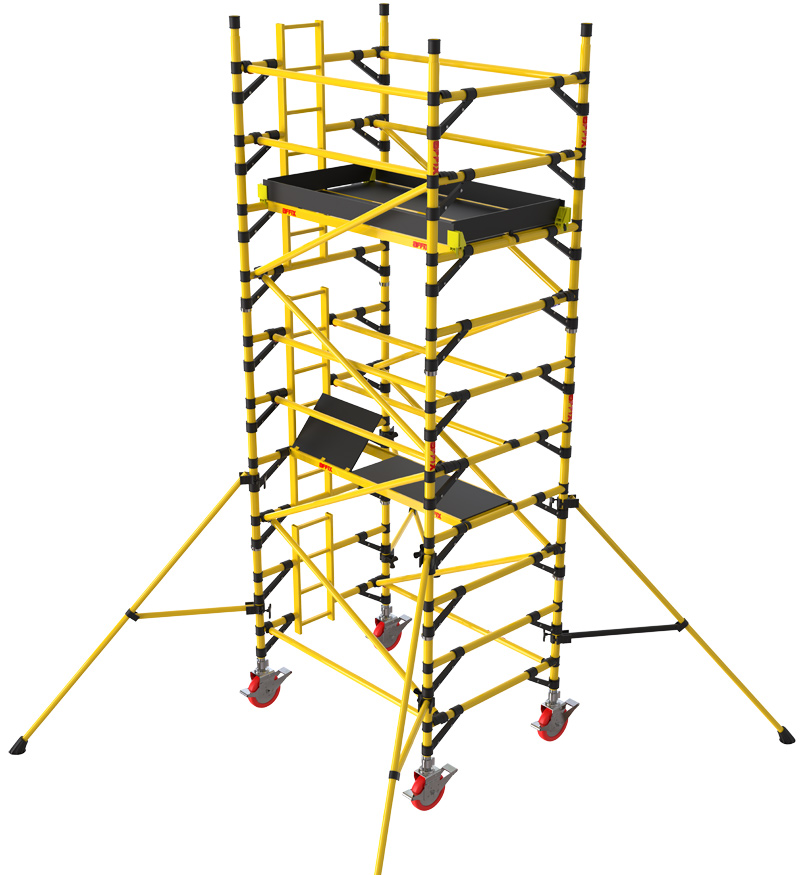
What FRP Scaffold Construction Means in Practice
FRP generally refers to fibre-reinforced polymer or fibre-reinforced plastic. Manufacturers combine reinforcing fibres with a polymer matrix to create structural components, but formulations and component designs vary considerably between products. Consequently, buyers should never assume that two FRP towers provide identical mechanical, electrical, chemical, or environmental performance.
Non-metallic structural components may attract attention where metallic equipment presents specific concerns. However, manufacturers can incorporate different materials into complete assemblies, including castors, locks, fittings, platforms, joints, and other components. Therefore, procurement teams should assess the complete product rather than infer system characteristics from the FRP designation alone.
Important product-specific checks include:
-
structural configuration and intended applications;
-
documented platform and system loading;
-
component materials and construction;
-
environmental limitations;
-
electrical performance information where relevant;
-
chemical compatibility information where exposure exists;
-
approved accessories and stabilising equipment;
-
inspection and maintenance instructions.
Where FRP Access Systems May Fit
Project teams may consider FRP scaffold towers for electrical maintenance, utilities, industrial plants, chemical-processing facilities, water-treatment operations, commercial maintenance, inspection, construction, and specialised access tasks.
Suitability still depends on the actual hazard assessment. An electrical maintenance task creates different concerns from work around chemical processing equipment, while an outdoor inspection introduces different conditions from controlled indoor maintenance. Similarly, restricted spaces may favour one configuration, whereas work requiring substantial platform area may require another.
Before specifying equipment, teams should define the work position, expected loading, duration, access route, surface condition, surrounding operations, environmental exposure, and relevant hazards. They can then compare those requirements with manufacturer documentation.
Why Electrical Conditions Change Scaffold Selection
Some organisations consider appropriately designed FRP access equipment where electrical hazards influence material selection. However, users should never interpret the term FRP as a guarantee of electrical insulation or protection against electric shock.
Electrical performance can depend on:
-
fibre and resin composition;
-
complete product design;
-
moisture and contamination;
-
surface condition;
-
physical damage;
-
incorporated components;
-
manufacturer testing and ratings;
-
environmental conditions.
Dust, conductive contamination, moisture, damage, or unsuitable components may alter practical conditions around equipment. Therefore, users must verify electrical performance information for the exact scaffold system rather than rely on general statements about fibreglass.
Most importantly, equipment selection cannot replace electrical safety controls. Site teams must continue to follow applicable isolation procedures, lockout arrangements, safe approach requirements, risk controls, and competent electrical working practices. FRP material characteristics form only one part of a broader electrical hazard-control strategy.
Chemical Exposure Requires Product-Specific Checks
FRP may receive consideration where corrosion or chemical exposure affects conventional equipment choices. Nevertheless, no responsible assessment should describe every FRP scaffold as resistant to every chemical or corrosive environment.
Material compatibility can change with the chemical involved, concentration, temperature, exposure duration, resin formulation, reinforcing material, surface condition, cleaning products, and component construction. Moreover, joints, castors, fittings, platforms, or accessories may respond differently from primary structural members.
Where chemical exposure drives equipment selection, buyers should request product-specific compatibility information. They should identify the substances present at the site, expected exposure conditions, cleaning agents, and possible contamination before comparing documentation.
Saudi Conditions Require Environmental Assessment
Saudi projects can involve high ambient temperatures, intense solar exposure, dust, sand, wind, coastal conditions, industrial contamination, chemical exposure, and outdoor storage. These factors do not automatically make FRP unsuitable; instead, they create questions that project teams should address through manufacturer information and site controls.
Prolonged sunlight and temperature exposure deserve consideration where manufacturers specify environmental limits or storage conditions. Meanwhile, dust and sand can accumulate around joints, locks, platforms, castors, and connection points. Cleaning and inspection should therefore focus on areas where contamination could interfere with secure assembly or movement.
Wind becomes particularly significant for exposed towers because it affects the complete structure rather than merely its material. Teams should follow product-specific limitations and site procedures instead of applying an assumed universal threshold.
Coastal and industrial environments can introduce additional contaminants. Consequently, buyers should examine the materials used throughout the complete scaffold and verify relevant compatibility information.
FRP and Aluminium Solve Different Access Problems
FRP and aluminium towers can both provide mobile or modular access, but material characteristics and product designs differ. Aluminium systems often attract consideration for handling and mobility, while FRP systems may receive attention where electrical or corrosive conditions influence material choice.
Neither comparison supports a universal winner. Instead, assess:
-
intended work and hazard profile;
-
electrical considerations;
-
chemical or corrosive exposure;
-
documented loading;
-
tower configuration;
-
handling and transport;
-
environmental limitations;
-
inspection requirements;
-
maintenance arrangements;
-
component and replacement availability.
An aluminium tower that suits routine indoor maintenance may not address a specialised electrical environment in the same manner as an appropriately specified FRP system. Conversely, choosing FRP without verifying its documented performance can create false confidence.
FRP and Steel Require Task-Based Comparison
Steel scaffolding may serve structural and access requirements that differ considerably from mobile FRP tower applications. Therefore, comparisons should focus on complete systems rather than broad assumptions about material strength, weight, or service life.
Project teams should compare intended configuration, loading requirements, handling, transport, corrosion considerations, environmental exposure, available components, project duration, and manufacturer specifications.
For specialised environments, material behaviour may carry greater significance. For other projects, configuration availability, required working area, structural demands, or access arrangements may dominate the decision. Consequently, procurement teams should start with the work requirement and hazard assessment rather than selecting material first.
Tower Configuration Should Follow the Task
FRP access equipment may include mobile towers, single-width or double-width configurations, different platform arrangements, castor-equipped systems, and compact or folding designs where manufacturers offer them. Availability varies, so buyers should verify actual product options.
Single-width towers may suit restricted areas, while wider configurations may provide additional working space where floor area permits. Mobile arrangements can support tasks that progress across suitable surfaces. However, mobility introduces castor, route, locking, and surface considerations.
Selection should account for:
-
required working position;
-
available base area;
-
access route and doorway restrictions;
-
platform space requirements;
-
expected personnel, tools, and materials;
-
approved tower configuration;
-
stabilising components;
-
floor or ground condition;
-
indoor or outdoor exposure.
Working Height and Platform Height Need Separate Checks
Platform height identifies the level where authorised users stand, while overall tower height describes the physical height of the assembled structure. Working height commonly relates to the reachable work level, although manufacturers and suppliers may define that measurement differently.
Human reach also varies. Consequently, customers should not apply an assumed formula to convert platform height into working height. Instead, they should confirm each measurement in the manufacturer’s documentation and select an approved platform position that supports the required work without unsafe reaching or improvised elevation.
Platform Space Must Match Work Requirements
Platform dimensions influence worker positioning, movement, tool placement, material handling, access, and task duration. A compact platform may suit inspection or light maintenance, while work involving equipment or materials may require more usable space.
However, greater platform area does not automatically increase safety or allowable loading. Teams must consider the approved number of users, access arrangements, available floor area, work positioning, and complete tower configuration.
Site constraints also matter. A wide platform can become impractical in corridors, congested industrial areas, or locations with equipment surrounding the work zone.
Load Capacity Comes From Product Documentation
Users must verify the manufacturer’s rated capacity for the exact scaffold model and configuration. They should never transfer a rating from another FRP tower or assume capacity from physical appearance.
Loading assessments should include:
-
authorised workers;
-
hand tools;
-
equipment;
-
materials;
-
total platform loading;
-
load distribution;
-
concentrated loading where relevant;
-
complete system limitations.
Project teams should also control materials placed on the platform during work. A tower designed for access should not become an uncontrolled storage area merely because unused platform space remains available.
Stability Depends on the Complete Configuration
FRP construction does not remove conventional stability requirements. Ground or floor condition, levelness, tower geometry, height, base dimensions, stabilising equipment, castors, environmental exposure, and nearby hazards all influence stability.
Where manufacturers specify outriggers or stabilisers, users should install the correct compatible components in the approved arrangement. They should never improvise extensions, supports, packing, or mixed-system components to compensate for an unsuitable base.
Before positioning a tower, assess:
-
surface firmness and condition;
-
levelness within product requirements;
-
stabiliser clearance;
-
nearby openings or edges;
-
vehicle and pedestrian movement;
-
overhead obstructions;
-
environmental exposure;
-
accidental impact risks.
Mobile Towers Need Controlled Relocation
Castors can support efficient relocation across suitable surfaces, but mobility introduces additional hazards. Brakes or locking mechanisms must operate correctly, and the route must suit the tower and manufacturer requirements.
Before relocation, teams should assess slopes, uneven surfaces, debris, floor transitions, overhead hazards, nearby workers, equipment, cables, and other obstructions. They should also control tools and materials according to approved procedures.
General content should not assume that moving an occupied tower is acceptable. Instead, users should follow the manufacturer’s instructions and site procedures for the specific equipment.
Indoor and Outdoor Use Requires Different Checks
Indoor projects often involve smooth floors and controlled environmental conditions, yet doorways, ceiling clearance, electrical installations, pedestrian traffic, confined areas, and finished surfaces can restrict tower selection.
Outdoor work adds wind, sunlight, dust, uneven ground, vehicle movement, changing conditions, and prolonged environmental exposure. Consequently, teams should reassess equipment before transferring an indoor configuration outside.
External work also requires consideration of the surrounding zone. Excavations, open edges, passing vehicles, loose surfaces, overhead services, and limited stabiliser space may affect suitability even where the immediate base appears adequate.
Assembly Must Follow the Approved System
FRP scaffold designs vary in frames, braces, platforms, guardrails, access arrangements, castors, stabilisers, joints, and locking mechanisms. Therefore, users should follow the manufacturer’s assembly instructions for the exact model and configuration.
Assembly planning should address:
-
correct component identification;
-
compatible frames and braces;
-
approved platform positions;
-
required guardrail components;
-
designated access arrangements;
-
stabilisers where specified;
-
castor installation and locking;
-
final inspection before use.
Improvised configurations can alter structural behaviour, access, stability, or protective arrangements. Consequently, site teams should never substitute undocumented assembly practices for manufacturer instructions.
Component Compatibility Requires Positive Verification
Components from different FRP systems may look similar without sharing compatible dimensions, locking mechanisms, connection geometry, structural functions, or material characteristics.
Users should verify manufacturer compatibility before combining parts. Physical fit alone provides insufficient evidence because a component may connect without performing correctly within the engineered configuration.
Storage and transport practices should keep systems identifiable and separated where mixing could occur. Clear component control also simplifies inspection, assembly, replacement, and inventory management.
What to Inspect Before an FRP Tower Enters Service
A general pre-use check supports safe equipment management but does not replace formal inspection procedures, competent assessment, or project requirements.
Teams should examine:
-
frames and structural members for visible damage;
-
surfaces for cracks, splits, or exposed fibres;
-
joints and connection points;
-
braces and locking arrangements;
-
platforms and access components;
-
guardrails and protective components;
-
castors, brakes, and moving parts;
-
stabilisers or outriggers where required;
-
base and surrounding surface conditions;
-
missing or unidentified components;
-
contamination around connections;
-
conformity with the approved configuration.
Questionable components should remain out of service until the responsible process determines their suitability.
FRP Inspection Requires Material-Specific Attention
Metallic scaffold inspection often draws attention to corrosion, but FRP components require additional visual consideration. Inspectors may encounter cracks, splits, surface damage, exposed fibres, deformation, damaged joints, worn connection areas, contamination, or other signs requiring assessment.
Not every surface mark carries identical significance. Therefore, inspectors should evaluate questionable conditions against manufacturer criteria and site procedures rather than making assumptions from appearance alone.
Castors, locks, platforms, fittings, and accessories also require inspection because the complete system can contain materials and mechanisms with different deterioration patterns.
Cleaning Should Protect Material and Connections
Cleaning removes dust, sand, chemical residue, and other contaminants that can obscure damage or interfere with connections. However, cleaning products themselves may affect particular resin systems, coatings, fittings, or accessories.
Teams should use methods and substances compatible with manufacturer requirements. They should pay particular attention to joints, locking areas, platforms, castors, and connection points, then allow appropriate drying where necessary.
After significant contamination or cleaning, inspection can identify damage or residual material that requires further action.
Storage and Transport Affect Equipment Condition
Organised handling protects components between projects. Storage arrangements should prevent unnecessary impacts, uncontrolled stacking, system mixing, contamination, and damage to connection points.
Teams should keep components identifiable, separate questionable parts, and follow manufacturer storage requirements. Where outdoor storage occurs, environmental exposure deserves specific consideration.
Transport can introduce impact, abrasion, movement, or component mixing. Consequently, users should secure equipment appropriately and inspect relevant components after transport before returning them to service.
Buying or Renting Depends on Usage Patterns
Purchase may suit organisations with recurring requirements, predictable configurations, suitable storage, transport capability, and established inspection and maintenance arrangements. However, ownership also creates responsibilities for component control, replacement, storage, and ongoing equipment management.
Rental may suit shorter projects or changing configuration requirements. Before hiring, customers should examine availability, delivery, collection, documentation, equipment condition, inspection information, damage responsibilities, and replacement arrangements.
Neither approach suits every project. Procurement teams should compare total operational requirements alongside acquisition or rental terms.
Supplier Evaluation Should Focus on Evidence
A useful supplier or rental assessment examines documented product capability rather than promotional claims.
Buyers can ask:
-
Which tower configurations are available?
-
How does the manufacturer define working and platform height?
-
What rated capacities apply to each configuration?
-
Which assembly instructions accompany the system?
-
What electrical performance information exists where relevant?
-
What chemical compatibility information supports specialised environments?
-
Which components belong to the approved system?
-
What inspection information accompanies the equipment?
-
Are replacement components available?
-
What delivery, collection, and rental responsibilities apply?
Application Conditions Change Selection Priorities
Electrical maintenance places greater emphasis on verified product performance and electrical controls. Chemical environments require compatibility checks against actual substances and exposure conditions. Industrial plants may add contamination, restricted areas, adjacent processes, and operational traffic.
Warehouse maintenance can prioritise mobility, floor condition, overhead obstructions, and work positioning. Meanwhile, commercial building work may involve narrow access routes, finished floors, occupants, and ceiling restrictions.
Outdoor inspection adds wind, sunlight, dust, terrain, and changing conditions. MEP installation may introduce tools, materials, overhead services, and longer platform occupancy. Therefore, each task requires a fresh assessment of configuration, environment, loading, access, mobility, and documented equipment capability.
Select FRP Scaffolding Around the Complete Risk Profile
FRP scaffolding selection should begin with the work task, hazard profile, required access, environment, loading, platform needs, and approved configuration. Electrical or chemical conditions may make material characteristics particularly relevant, but they never remove the need for appropriate safety controls. Saudi heat, sunlight, dust, wind, coastal exposure, and industrial contamination can add further inspection and storage considerations. Project teams should verify manufacturer specifications, equipment condition, compatibility, site procedures, risk assessments, and current applicable requirements before placing any tower into service.
FAQs
What is FRP scaffolding commonly used for?
FRP scaffold towers may support electrical maintenance, industrial work, chemical-processing environments, utilities, facility maintenance, construction, inspection, and specialised access tasks. Suitability depends on the exact product, task, hazard assessment, configuration, environmental exposure, platform requirements, loading, and manufacturer specifications rather than the FRP material designation alone.
Is FRP scaffolding suitable for electrical work?
Some appropriately designed FRP systems may receive consideration where electrical hazards affect equipment selection. However, FRP does not guarantee insulation or make live work safe. Users must verify manufacturer electrical performance information and continue applying isolation, lockout, approach-distance, risk-control, and competent electrical working procedures required for the task.
How does FRP scaffolding differ from aluminium scaffolding?
The systems differ primarily in material construction and potentially relevant performance characteristics. FRP may attract consideration for particular electrical or corrosive environments, while aluminium may offer different handling and availability characteristics. Buyers should compare documented specifications, configuration, loading, environment, inspection requirements, mobility, and task-specific hazards rather than rank materials generally.
Can FRP scaffold towers be used outdoors in Saudi Arabia?
Outdoor suitability depends on the exact system and manufacturer requirements. Saudi sites can introduce sunlight, heat, dust, sand, wind, uneven surfaces, coastal exposure, and vehicle movement. Teams should assess actual conditions, verify environmental limitations, inspect equipment carefully, provide suitable stability, and follow approved operating and storage procedures.
Does FRP resist chemicals and corrosion?
FRP can offer useful characteristics in some corrosive or chemical environments, but resistance is not universal. Performance can vary with resin composition, reinforcing material, chemical type, concentration, temperature, exposure duration, component design, and condition. Buyers should verify product-specific chemical compatibility information for the substances and exposure expected onsite.
How should users select the required working height?
Users should identify the actual work position and distinguish platform height, working height, and overall tower height. Because manufacturers may define measurements differently, customers should verify technical documentation instead of applying a universal reach calculation. The selected approved platform position should support the task without unsafe reaching or improvised elevation.
What should users inspect before using an FRP scaffold?
Check structural members, surfaces, joints, braces, platforms, guardrails, access components, castors, locks, stabilisers, base conditions, contamination, and component completeness. Look for cracks, splits, exposed fibres, deformation, damaged connections, or other questionable conditions. Follow manufacturer criteria and formal site inspection requirements before returning doubtful equipment to service.
Can components from different FRP systems be mixed?
Users should never assume compatibility from appearance or physical fit. Different systems can use distinct dimensions, connections, locking mechanisms, structural functions, and material specifications. Combine components only where manufacturer documentation supports the arrangement. Keeping separate systems identifiable during storage and transport also reduces accidental mixing during assembly.
Should a project rent or purchase FRP scaffolding?
Purchase may suit recurring, predictable access requirements where an organisation can manage storage, transport, inspection, maintenance, and component control. Rental may suit shorter projects or changing configurations. Procurement teams should compare project duration, availability, required equipment, documentation, delivery, collection, damage responsibilities, replacement arrangements, and long-term usage patterns.
What should buyers check before choosing an FRP supplier?
Buyers should request technical specifications, available configurations, height definitions, rated capacities, assembly instructions, component lists, inspection information, and replacement-part availability. Where relevant, they should also request documented electrical performance and chemical compatibility information. Delivery, collection, equipment condition, rental responsibilities, and manufacturer documentation deserve equal attention before commitment.


Comments
Post a Comment